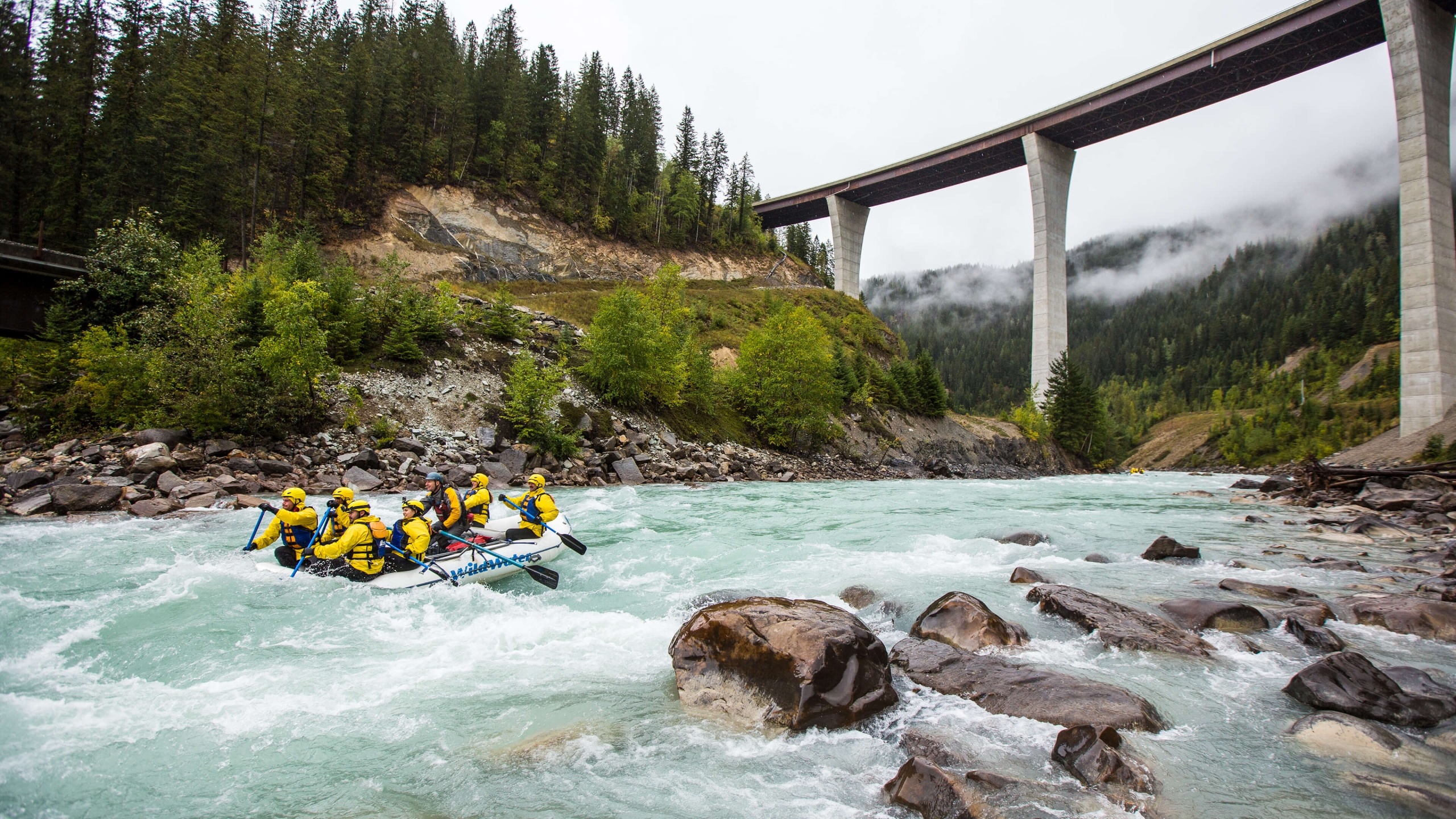
With millions of hectares of mountains and over 100 major river systems, British Columbia has no shortage of excellent river and whitewater rafting opportunities. Old-growth forest, glacier-capped peaks and isolated waterfalls are just a few of the natural marvels that might be seen on a guided rafting expedition.
Three kinds of river rafting experiences are offered by British Columbia's licensed operators: paddle trips, motor-powered trips, and float trips.
Paddle trips require the most active involvement as guests must paddle the raft as the guide steers. Motor-powered trips, available on some deeper rivers, require no paddling, though guests must be able to hold on tight. On a float trip, paddling is usually optional as guides often propel and steer the raft with large oars; float trips are often accessible to people of all ages and abilities.
Guided trips will range in length from several hours to several days. On multi-day trips, accommodation may range from a simple tent in the woods to a cabin at a dedicated rafting resort.
Learn more about river rafting in BC's regions
Vancouver, Coast & Mountains: Home to the mighty Fraser Canyon, the "Rafting Capital of Canada," and great whitewater around Squamish and Whistler.
Vancouver Island: Tackle more than 40 sets of Class II and III rapids over 20km/12.4mi on the Lower Nimpkish River.
Thompson Okanagan: Warm waters and reliably sunny weather make this region's famous rafting hotspots – the Thompson, Adams and Clearwater rivers – even more appealing.
Kootenay Rockies: Visit premier whitewater rafting destinations like the Kicking Horse and Kootenay rivers.
Northern British Columbia: See grizzlies and glaciers from the Tatshenshini, Babine, or Bulkley rivers.
Cariboo Chilcotin Coast: Glacier-fed river systems like the Chilko-Chilcotin-Fraser are dominated by rapids ranging from Class II to Class IV.
When to Go Rafting
BC is a large province – roughly the size of France and Germany combined – and climate varies greatly by region. In southern parts of the province the rafting season generally runs from May or June to September, but in the north, the window is much smaller – usually just July and August. Check with individual operators for precise seasons.
Practical Points and Rafting Safety
- Whitewater rafting poses inherent risks, but with proper guidance, preparation and common sense, these risks are greatly diminished. Nonetheless, companies will require participants to sign a waiver and release of liability prior to setting out.
- Rafting in BC is strictly regulated by the provincial government, and rafting companies will provide certified and experienced guides who ensure that trips are as safe and enjoyable as possible. Always arrange your trip with a licensed river rafting company.
- Generally, kids age 10 and older can participate in most rafting trips, though more difficult runs require stronger paddling and may have a minimum age of 15 or 16. Some of the more low-key motorized and float trips are suitable for people of all ages and fitness levels. Age and fitness restrictions will vary by operating company and by route, so always check with the company in advance.
- All specialized gear — including wetsuits, lifejackets, waterproof jackets, helmets and paddles — is typically provided by the operating company. Guests are usually advised to bring a few items; check with the individual company before you go.
- Always book your rafting trip in advance.
River and Whitewater Rafting Highlight Areas
Fraser River (Thompson Okanagan / Vancouver, Coast & Mountains)
Rising near Mount Robson in the Canadian Rockies and emptying into the Pacific Ocean almost 1,400km/870mi later, BC's longest river is home to a huge variety of scenic rafting opportunities, from the intensity of the Fraser Canyon to the peacefulness of its wider sections.
Stein River (Vancouver, Coast & Mountains)
The steepest commercially-rafted river in Canada (with a drop of 27 metres per kilometre, or 145 feet per mile) is also one of BC's only commercially-rafted Class Vs — a big draw for extreme paddlers the world over.
Tatshenshini-Alsek River System (Northern BC)
Raft past the glaciers and grizzlies that inhabit this majestic bio-reserve, designated a UNESCO World Heritage Site.
Lytton (Vancouver, Coast & Mountains)
The town of Lytton is known as the "Rafting Capital of Canada" thanks to its location at the confluence of the Fraser and Thompson rivers, two of BC's largest.
Brackendale (Vancouver, Coast & Mountains)
In winter, head to Brackendale (just north of Squamish) and take a float trip to see bald eagles lured by the local rivers' spawning salmon.
The International Rapid Rating Scale
BC's diverse rivers present rafters with varying degrees of difficulty. When choosing a river rafting trip that's right for you, consider the international rapid rating scale.
Had a Great BC Rafting Experience?
We want to know about it! Let other visitors in on what you think are the best whitewater/river rafting spots in the province. Write a short blog about it and share your tips and stories!
Show Less