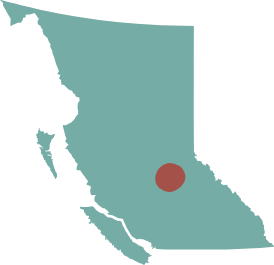
Cutting a treacherous path through jagged mountains, the Fraser River has created what is, arguably, one of the finest river canyon landscapes in the world.
Its extraordinarily diverse geography makes Lytton (area population 1,300) a top choice for adventurers who enjoy hiking, geocaching, mountain biking and whitewater rafting. Hell's Gate Airtram is a star attraction and wilderness parks like the Stein Valley, with its rich First Nations heritage, are hidden jewels.
Add to this the canyon's hard-earned sagas of early explorers, gold rush pioneers and railroads that blasted a passage through the cliffs to secure a nation, and the canyon holds the promise to yield any number of historic sites, intriguing art, inspired photography, wildlife and festivals that celebrate its folklore and history.
Circle Routes
The Fraser Canyon's southerly gateway is Hope, a 90-minute drive east of Vancouver and a three-hour drive from Seattle. It can also be accessed from the west in a 3-hour drive from Whistler via Lillooet as well as from the east from Kamloops via Cache Creek. As a result, many travelers make the canyon a part of a circle tour to include the Interior or the Coast Mountain Range, stopping off at historic Yale, Boston Bar and Lytton, the largest of the three communities.
When traveling any canyon route, be aware that cell phone service is virtually non-existent so be sure to stock up with gas and supplies at every opportunity.
Retracing History
The Fraser Canyon's do-or-die history adds a depth of experience and spirit to the communities here – a palpable pride that fuels an enthusiasm to celebrate its past as its foundation for the future. For example, although Yale's population is barely 300, when gold was discovered it was once the largest town west of Chicago with 30,000 miners.
Railway Construction
No sooner had canyon prospectors moved on, than the Canadian Pacific Railway commenced construction, employing more than 6,500 Chinese laborers and 2,500 white workers to cut the line between Yale and Lytton. Today, evidence of Yale's Chinese community is still very prominent and in Lytton, look to the fields of boulders near the Stein Valley benchlands. The boulder fields were created by Chinese workers who moved rocks from the river that had been long abandoned by earlier prospectors.
Lytton's Claims to Fame
At one time, Lytton grew to such prominence that it even petitioned to be named the capital of British Columbia. Alas, it was not to be and has, in more modern times, settled to be known as one of the top spots in Canada for whitewater river rafting instead. As for its other claim to fame? The town takes its name after English novelist, Sir Edward Bulwer Lytton who is most famous for writing introductions like "It was a dark and stormy night…"
Lytton in Winter
Come winter, canyon activity slows to a gentler pace and while several campsites, restaurants and attractions either close or operate on reduced hours, a drive through its spectacular scenery is as awe-inspiring in cold months as it is in the height of summer.
Rock Hounding, Trainspotting & Snowmobiling
The textured, mineral-rich colours of the mountainsides look richer and with lower water levels, rock hounders arrive to scour the pebbly shores and sandbars, not for gold, but for geodes, jade and other semi-precious stones. Train spotting continues through all weathers and when the snows arrive, snowmobile owners take to the trails around Boston Bar and Lytton.
Visit the Lytton Visitor Centre (400 Fraser St) for information on the canyon's many adventures. If the call of gold strikes a chord, the centre also sells panning equipment!
Read Less