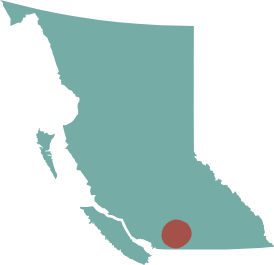
Many Langley families have resided for generations in this agricultural, yet modern Fraser Valley community east of Vancouver.
Their pride and passion is easy to understand when visiting local museums and historic and heritage sites.
To discover the roots of Langley and indeed British Columbia itself, look no further than the historic village of Fort Langley on the south bank of the Fraser River.
The surrounding area, about 50km/31mi from the mouth of the Fraser River, was originally inhabited by the Kwantlen First Nations people, who fished, hunted and traded here with other Coast Salish nations.
In 1827, the Hudson's Bay Company (HBC) set up a trading post in what is now Derby Reach Regional Park. Fur trading and salmon canning became staple industries at Fort Langley, and HBC employees married local women and set up farms to sustain themselves and other Pacific forts.
The fort was relocated up the river in 1839, but burned down after just 10 months and had to be rebuilt on the same site in 1840. This remains its current location.
In 1858, the Fraser River Gold Rush kicked off. Queen Victoria and the British Parliament now chose to transform what was originally just a coastal trading zone into the full-fledged Crown Colony of British Columbia. Sir James Douglas, who would serve as British Columbia's first governor, presided over the official proclamation at the Big House in Fort Langley on November 19, 1858.
From Trading Post to National Historic Site
Fort Langley's economic and strategic importance declined after the proclamation. The old trade routes with California, Hawaii, and Alaska withered away. By 1886, Fort Langley had ceased operating as an HBC trading post.
Fortunately, Fort Langley's rich heritage wasn't forgotten. Its historical importance was recognized with a commemorative plaque in 1925, and in 1955, it was designated a National Historic Site. Today, Fort Langley National Historic Site attracts some 60,000 visitors a year.
Growth of Modern Langley
As the 20th century progressed, farming remained a major economic driver throughout Langley. With its rich farmland, Langley produced poultry, beef, cranberries, dairy, and other agricultural goods in copious amounts. Its horse-loving citizens also built the community's reputation as the "Horse Capital of BC," and today there are thousands of horses in Langley. Take horseback riding lessons, go for guided trail rides or catch a rodeo.
After the Second World War, the population grew due to increasing urban development. The City of Langley, focused on the downtown core, was established in 1955, while the surrounding territory would be known as the Township of Langley.
The coming of the Trans-Canada Highway in the 1960s increased commercial investment in Langley. High-tech companies, warehouses, and wineries set up shop in the area. In recent years, culinary tourism with circle routes and wine tours has flourished, along with outdoor recreation like golf, and cultural experiences. Reflecting a commitment to education, Langley has two universities: the faith-based Trinity Western University, and a satellite campus of Kwantlen Polytechnic University.
Museums and Festivals
Learn more about Langley's culture and history at various attractions, including Fort Langley National Historic Site, the Langley Centennial Museum, and the BC Farm Machinery & Agricutural Museum.
Langley celebrates its culture with colourful festivals year-round. Check out the May Day celebrations, the Canada Day (July 1) celebrations, the Langley Good Times Cruise-In (September) car extravanganza, or the Cranberry Festival (October), to name a few.
Read Less